Trade show ROI is the value an exhibition generates for the business, set against the full cost of taking part, expressed as a percentage.
The formula is straightforward. Subtract the total cost of exhibiting from the value it produced, then divide the result by the total cost.
The value side runs from qualified leads through to pipeline and closed revenue. Meanwhile, the cost side must include the stand, the staff, the travel, and the follow-up, not just the floor space fee.
What counts as trade show ROI

According to the Events Industry Alliance’s 2025 SASIE report, UK exhibitions contributed an estimated £11.5 billion in economic output last year. They supported around 126,000 jobs across roughly 1,150 exhibitions and conferences held at the country’s major venues, drawing some 6.8 million visits.
A channel operating at that scale deserves a rigorous measurement standard. It should match the scrutiny you apply to digital marketing spend. Yet, we still too often reduce trade show ROI to the wrong question. We ask whether the stand looked good and the team felt busy.
The real measure runs further than the show floor. It starts with footfall and conversation on the day. However, the value that actually counts lies in what those conversations become afterward. Success means converting them into qualified leads, formal opportunities, and ultimately revenue you can trace back to the event.
For exhibitions selling considered, higher-value products, that journey rarely finishes inside the show itself. Any honest measure of return must follow the lead long after you pack away the stand. Intangible outcomes are real and worth recording. These include relationships strengthened with existing customers or intelligence gathered on competitors. However, they should sit alongside the financial measure rather than stand in for it when the numbers are less convincing.
The trade show ROI formula, with a worked example
The formula itself for how to calculate ROI on trade shows is simple:
Return on investment is calculated as the value generated minus the total cost, divided by the total cost, then expressed as a percentage.
The work lies in being honest about both sides of that equation. The value side should only include leads that have actually been qualified. Likewise, the cost side should include everything spent on getting to the show and following up afterward, not just the space.
The worked example below shows how this looks in practice for a UK manufacturing exhibitor. They have a 9 square metre stand at a regional trade show. These figures are illustrative rather than typical. No two shows, sectors, or stands produce the same numbers. However, you can apply this exact method to your own:
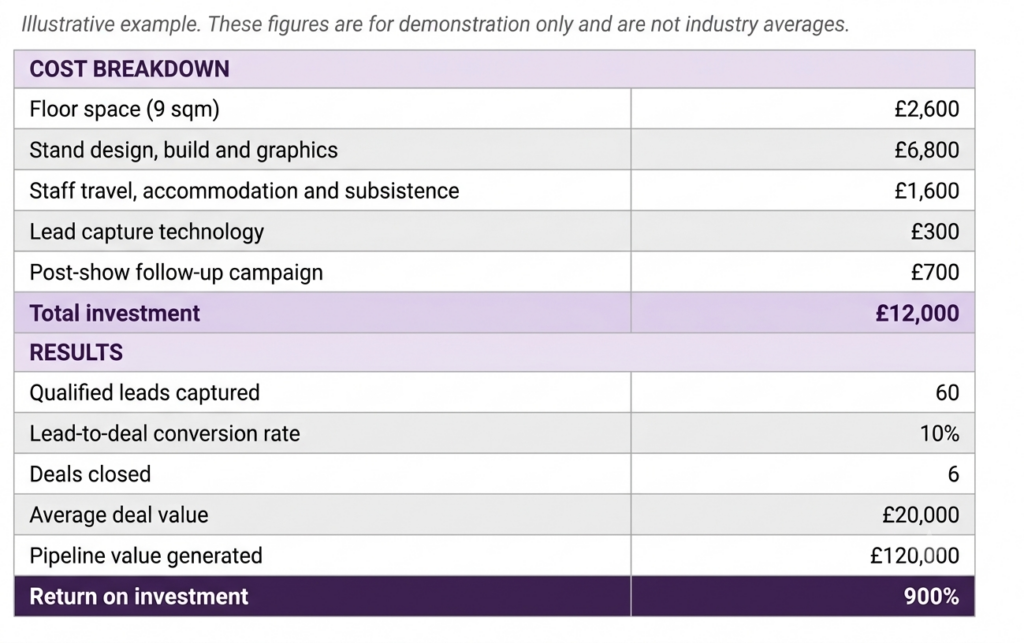
In this example, the £120,000 in pipeline generated from six closed deals is ten times the £12,000 invested. That represents a return of 900%. This is a healthy outcome for a single show. It illustrates why average deal value matters so much to the calculation.
The same stand producing the same sixty leads would tell a very different story for a business selling a £2,000 product rather than a £20,000 one. This is exactly why a borrowed industry average is never useful. You need to run your own numbers through your own formula.
What a good trade show ROI looks like
Marketers searching for a single benchmark figure for a good trade show ROI will not find one that holds up to scrutiny. Published figures vary enormously from source to source and are rarely specific to the UK market. They depend on factors that differ wildly between sectors and even between shows in the same sector. These include average deal value, typical sales cycle length, and realistic lead volumes for a given stand size.
Borrowing someone else’s number and treating it as a pass mark is dangerous. It is one of the quickest ways to draw the wrong conclusion about a show that genuinely worked, or to keep funding one that did not.
The more useful approach is to set your own target before the show. Build it from what an equivalent volume of qualified pipeline costs you to generate through a channel you already measure with confidence, such as paid search or outbound. Judge the exhibition against that internal benchmark rather than an imported industry average. The comparison will then tell you something you can actually act on.
The full cost of exhibiting, beyond the space fee
The single biggest distortion in any trade show ROI calculation is an incomplete cost side. The floor space fee is usually the number a business budgets against first. However, it is rarely the only one, or even the largest.
A full and honest figure includes the stand itself, whether hired, bought, or custom-built. You must also include its graphics, furniture, lighting, and AV. It includes staff time, which remains a real cost even when no invoice arrives for it. Do not forget their travel, accommodation, and subsistence for however many days the show runs.
Venue extras are easy to miss and add up quickly. Venues commonly charge separately for additional power sockets and rigging for graphics above the stand. Each can easily add a four-figure sum to the final bill. Lead capture technology, pre-show marketing, and post-show follow-up all belong on the cost side too. None of them are optional if the exhibition is meant to produce a measurable return.
One factor worth building into the calculation from the outset is whether the stand itself is reusable. A modular build returns to the floor across several shows. It spreads its cost over each appearance rather than repeating it in full every time. This changes the economics of the whole programme. It is one of the reasons a responsibly designed, reusable stand tends to outperform a single-use custom build on cost per show over a multi-year view.
The metrics that actually predict return
Not every number generated on a stand predicts whether the show will pay for itself. Treating them as equally important is a common source of confusion. Footfall and the number of badges scanned describe attention. This matters for brand visibility, but it says nothing on its own about commercial return.
The metrics that do predict return are narrower:
- Cost per qualified lead: This only counts leads that genuinely match the target buyer profile.
- Conversion rate: The pace at which qualified leads become formal opportunities.
- Pipeline value: The total financial value those opportunities represent.
- Closed-won revenue: The final sales that teams can trace back to the show.
Research from CEIR, the Center for Exhibition Industry Research, confirms this focus. They found that lead volume and post-show closed deals are the metrics organisations rely on most heavily when judging exhibition ROI. This lines up with the experience of anyone who has run a stand programme for more than a season or two.
The takeaway is to track fewer numbers properly rather than more numbers loosely. Agree on which of them counts as success before the show opens, not after it closes.
How to attribute revenue when the sales cycle is long
For most considered B2B purchases, closing a deal in the weeks immediately after a show is the exception, not the rule. A measurement approach that only looks at the show week will undercount the real return badly.
The discipline that fixes this starts in the CRM rather than on the stand. Every lead captured at the show should be tagged at the point of capture with its source and the specific event it came from. That tag must survive however many further touchpoints, calls, and proposals the deal goes through before it closes.
Treat the exhibition as one assisting touch among several, rather than insisting it take full or no credit for a deal. This gives a fairer picture of its contribution. It also avoids the trap of dismissing a show because the immediate, single-touch numbers look thin.
It is also worth comparing exhibition-sourced deals against your other channels on velocity and average size, not just on volume. A slower but larger and more qualified pipeline from a show can easily outperform a faster but smaller one from elsewhere once the full sales cycle plays out.
How to present ROI to your board
A board presentation that lists every metric a stand produced usually persuades nobody. It asks the audience to do the work of finding the headline themselves.
The stronger approach leads with a small number of figures. Typically, this means the total cost, the qualified pipeline generated, and the resulting ROI percentage. Set these out using the same formula the business applies to its other marketing channels so the comparison is fair rather than flattering.
Show the full cost honestly, staff time and travel included. A board that later discovers a more complete figure will trust every future report less.
Qualitative wins belong in the presentation as supporting colour rather than as the primary case. These include relationships strengthened with existing accounts or useful intelligence gathered on competitors. Numbers that need a story to carry them are usually numbers that are not yet good enough to stand alone.
Finally, commit to a follow-up date once the sales cycle has had time to play out. This ensures the board sees the forecast checked against what actually closed, rather than a projection that is never revisited.
The mistakes that sink most ROI calculations
A handful of avoidable mistakes account for most of the unreliable ROI figures presented after a show:
- Counting every interaction: The most common mistake is counting every business card or badge scan as a lead. This inflates the apparent volume of opportunity while hiding the real cost of generating pipeline.
- Ignoring hidden costs: A close second is leaving staff time and travel off the cost side entirely. This makes even an average show look artificially efficient.
- Short-term tracking: Measuring success only in the show week is another error. It punishes exhibitions for the very thing that makes face-to-face selling valuable.
- Poor CRM hygiene: Failing to tag exhibition-sourced leads in the CRM causes deals to lose their source entirely by the time they close. This erases the show’s contribution from the record.
- Retrospective targets: Setting no target before the show means success gets defined retrospectively. This almost always works in the show’s favor, turning measurement into mere reassurance.
- Misjudging assets: Treating a reusable stand as a one-off cost overstates the cost side. You should judge it across the several shows it will actually serve.
Frequently asked questions
What is a good ROI for a trade show?
There is no single reliable benchmark. Too much depends on deal value, sales cycle length, and your sector’s realistic lead volumes.
The more useful approach is to set your own target before the show based on what an equivalent volume of qualified pipeline costs you through other channels.
How do you calculate cost per lead at a trade show?
Divide the full cost of exhibiting by the number of qualified leads captured. Do not use total footfall or badge scans. Include space, stand, staff, travel, and follow-up.
Reliable, UK-specific cost-per-lead benchmarks are difficult to find in published research, so calculating your own figure from your own spend will tell you far more.
What KPIs should I track for trade show ROI?
Cost per qualified lead, lead-to-opportunity conversion rate, pipeline value generated, and closed-won revenue are the four that predict return most reliably. Footfall and badge scans describe attention, not financial value.
How do I prove exhibition ROI to my board?
Lead with a small number of headline figures set against the full cost, not a long list of metrics.
Use the same ROI formula you would apply to any other marketing channel. Keep qualitative wins secondary to the numbers.
How long does it take to see ROI from a trade show?
For considered B2B purchases, the return rarely lands inside the show week. Many exhibition-sourced deals close months later through a complex sales cycle. This is why tagging leads by source in the CRM at first capture matters so much.
Run the formula above against your last show before you commit to your next one. Alternatively, get in touch and talk it through with a team that has spent twenty years watching what actually happens on UK exhibition floors, and increasingly, beyond them.
We will help you build the case, the brief, and the stand to back it up.