Businesses are now evolving to keep customer experience their main priority to drive growth. This shift is vital. Nearly 90% of businesses will soon compete purely on customer experience, proving the importance of creating successful visitor journeys.
In a market saturated with choices, buyers can find an alternative with a single Google search. Therefore, identifying how your business can excel in customer service is a great place to start standing out from your competitors. After all, good customer experiences satisfy visitors and result in revenue growth.
The brands winning on the exhibition floor in 2027 do not necessarily have the biggest stands or the largest budgets. Instead, they think hardest about the customer experience. They design every touchpoint to deliver it deliberately.
Exhibition customer experience covers everything from pre-show communications to the follow-up email a week later. Every interaction, conversation, and design decision either builds or erodes your brand’s impression. In a digital world, the quality of your live experience is one of your few sustainable differentiators. Here is how to get it right.
What is customer experience?
Fundamentally, customer experience is a customer’s overall perception of their involvement with a company.
While this journey starts with the initial interaction (like a click onto your website), the exhibition environment is the perfect place to reinforce brand values. It allows you to showcase products and provide excellent face-to-face service.
Personalise Your Pre-Show Communications
The customer experience begins long before anyone sets foot on the show floor. The way you communicate with prospects and existing customers in the weeks leading up to an event shapes their expectations. Those expectations colour everything that follows.
Personalised pre-show outreach signals that you understand your audience. You should target your messaging by sector, role, or known interest to engage them on their terms. A generic email blast to your whole list is a missed opportunity.
Conversely, a short, relevant message that speaks directly to a prospect’s known challenges will drive action. Whether you send a personal invitation, a tailored insight piece, or early access to a product preview, the principle remains the same. The more relevant the communication, the more valued the recipient feels.
→ Our event planner tool can help you map and plan your pre-show activity as part of a broader exhibition strategy.
Design Your Stand Around the Visitor Journey
It is a natural instinct to use your exhibition stand primarily as a showcase for products and services. However, the brands that create the most memorable experiences do something more considered. They design the stand around the visitor’s physical journey, rather than just the story the brand wants to tell.
Mapping the Visitor’s Path
This process means defining your ideal visitor before making a single design decision. Where do they look first? What will pull them into the space? What question should they ask your team?
The physical layout, graphics, interactive elements, staffing positions, and furniture must all support that journey. Stand design and visitor experience design are inseparable.
Removing Friction from the Floor
A stand that is visually striking but difficult to navigate creates immediate friction. Unclear messaging from five metres away does the same.
A successful stand draws visitors in naturally, answers their unspoken questions, and creates comfortable conversation points. It makes the customer experience feel effortless. The experience should feel smooth from their side, even when the reality behind it requires high engineering.
→ See how our exhibition stand design process starts with visitor behaviour, not just aesthetics.
Build consistency across every channel
Data shows that 75% of people expect consistency when engaging with brands across social media and in person. If you want to enhance your customers’ experience, maintaining consistency across all platforms is a simple, effective way to satisfy them.
You should carry this same alignment into your post-show follow-up communications. Understand your product and your brand messages thoroughly. This knowledge allows you to deliver your insights in person with total confidence.
Visitors rarely encounter your brand for the first time at a trade show. Most have already seen your social content, visited your website, or received an email. What they experience at your stand needs to feel like a natural continuation of those past interactions.
Aligning Messaging and Brand Values
Consistency in tone of voice, visual identity, and core messaging forms your baseline. However, deep quality requires consistency of values. This includes the way your team talks to people, the questions they ask, and the care they show.
A brand that communicates warmth in its marketing but features disengaged staff sends a contradictory message at the worst moment. Brief your team thoroughly before every show. Make sure they understand the exact experience you want to create and the conversations you hope to spark.
Use activations and technology to deepen engagement
In an advancing technological generation, it is essential to involve technology into your exhibitions in some way, shape or form. Passive exhibition visitors are largely extinct. The people walking your show floor in 2027 have already done their research, shortlisted their options, and formed a view. Your job is not to inform them from scratch; it is to give them an experience that makes you the obvious choice once the show is over.
Purposeful Tech Integration
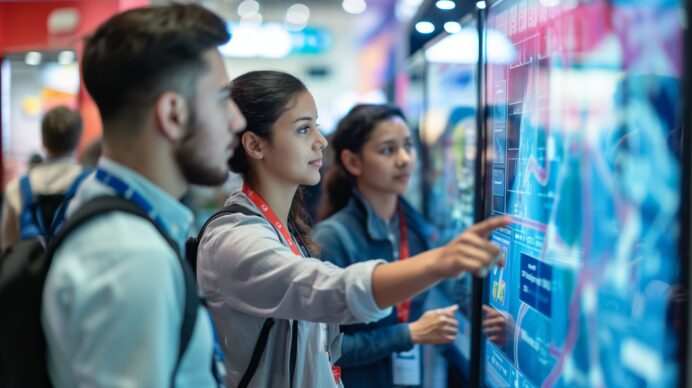
Interactive activations, whether that is gamification, AI-powered experiences, live demos, sensory environments, or digital storytelling, fundamentally change the quality of the customer experience on your stand. They create dwell time, conversation starters and memories. And they give people something to talk about with colleagues when they get back to the office, which is often where the actual buying decision gets made.
Technology should always serve the experience, not perform for its own sake. The best activations are the ones where a visitor barely notices the technology because they are too absorbed in the experience it has made possible.
→ Explore our full range of brand activation services and see what is possible for your next stand, from digital activations to gamification and sensory experiences.
Pay attention to non-verbal communication
Design and technology can only do so much. The human element of the customer experience at exhibitions remains irreplaceable. Body language and physical presence shape this element just as much as spoken words.
Staff members communicate negative impressions even when saying nothing. This happens when they position themselves awkwardly behind furniture or check their phones.
Conversely, a team that stands openly, makes natural eye contact, and shows genuine interest creates an inviting atmosphere. People respond to positive energy instinctively and avoid awkwardness. Your team’s presentation serves as a live expression of your brand values, and visitors judge it in seconds.
Consider the practical implications of your staff’s behavior. Plan where staff stand, how they open conversations, and how they handle questions when they do not know the answer. Finally, outline how they will transition a good conversation into a structured next step.
Follow up with purpose
The customer experience does not end when the visitor leaves your stand. For many brands, the post-show follow-up determines whether the experience consolidates or collapses.
A fast but generic follow-up email can quickly undo the goodwill built during a positive stand interaction. A thoughtful, personalised message that references your specific conversation reinforces everything you worked to communicate.
You should follow up within a few days of the event. Ensure the messaging reflects what you actually know about the recipient. Reference their specific interest, their business challenge, or a unique point from your talk. Make it clear that the conversation is continuing, rather than signaling that a aggressive sales process is beginning. This distinction matters immensely to the recipient.
→ Our Insights service helps you capture live data during events so that your post-show follow-up is informed, targeted, and effective.
Make sustainability part of the experience
Increasingly, the customer experience at an exhibition includes how an exhibitor expresses their values physically, not just verbally. A stand designed with sustainability in mind communicates meaning to visitors who share those values. To do this, use reusable systems, responsibly sourced materials, and a considered approach to waste.
At Tecna, we embed sustainability into how we design and build, rather than bolting it on as an afterthought. Every stand comes with a carbon footprint report. Furthermore, independent auditors verify our approach to ISO 20121 standards. For brands that want their exhibition presence to reflect a broader commitment to responsible practice, this verification matters.
→ Read more about our approach to sustainable exhibition stands.
Frequently asked questions:
What does customer experience mean in an exhibition context?
Exhibition customer experience refers to the full journey a visitor has with your brand at a show, from pre-event communications through to post-show follow-up. It encompasses stand design, staff behaviour, interactive elements, messaging consistency, and the quality of the conversations your team has. Every touchpoint contributes to the overall impression your brand leaves.
How do I measure customer experience at an exhibition?
Measurement starts with defining what a good experience looks like before the show. During the event, you can track dwell time, conversation volume, lead quality, and engagement with specific stand features. Post-show, customer feedback, lead conversion rates, and follow-up response rates all provide useful signals.
Our Insights service makes it possible to go well beyond simple footfall numbers, using visitor analytics and real-time engagement tracking to give you data you can actually act on.
How does stand design affect the customer experience?
Stand design has a direct and significant impact on the customer experience.
Layout determines how easily visitors can enter and navigate the space. Graphics and messaging shape the first impression from a distance. Interactive elements influence how long visitors stay and how engaged they become. Furniture placement affects whether conversations feel natural or awkward.
A well-designed exhibition stand makes every part of the experience feel intentional rather than accidental.
How important is staff behaviour to the exhibition customer experience?
It is one of the most important factors, and often the most underestimated. Visitors form strong impressions based on how your team presents themselves, how approachable they are, and how genuinely interested they seem. A brilliant stand with disengaged staff will underperform every time.
Bringing in brand ambassadors who understand your product and your audience can make a significant difference, particularly for larger shows or new markets where your internal team may be stretched.
Can a smaller stand deliver a great customer experience?
Absolutely. Stand size is one factor among many, and it is rarely the most important one. Clarity of message, quality of interaction, and the care put into every design decision matter far more than square footage.
Our modular and hybrid stand options are built precisely for brands that want to make a bold impression without requiring an enormous footprint, and some of the most memorable exhibition customer experiences happen on compact, well-considered stands where every element has been chosen with purpose.
How do I create consistency between my digital presence and my stand experience?
Start by auditing the touchpoints a typical visitor will encounter before they arrive: your website, social content, email communications, and any event-specific marketing.
Make sure tone, visual identity, and key messages are aligned across all of them. Then brief your team so that the conversations they have on stand reflect the same values and language.
If you are looking for support with branded merchandise or physical touchpoints that carry your brand consistently across the show floor, that is something we can help with too.
Talk to Team Tecna about your next show. We will help you build the case, the brief, and the stand to back it up.