Knowing how to choose trade shows is one of the most valuable things an exhibiting team can get right. Treat every show as a commercial decision, not a calendar habit. Judge each one on five things:
• Audience match
• Realistic commercial potential
• Full cost
• Strategic fit
• Evidence from previous exhibitors.
Any show that cannot earn its place on those five criteria should lose it.
Why Show Selection is a Strategy Decision
Most exhibition calendars are built by inheritance rather than analysis. A show earns its place because someone booked it last year, because the industry expects your brand there, or because a competitor has a stand a few rows over. None of those reasons survive scrutiny once the budget reaches six figures.

Start by being clear on why you are exhibiting at all. A show chosen to generate qualified leads needs a different evaluation from one chosen to support a product launch or defend market presence. From there, apply the same questions you would ask of any major marketing investment: who the show reaches, what it will likely return, and what it costs against alternative uses of that budget. A repeatable selection process protects against the slow drift that pulls most exhibition programmes towards habit, where the calendar fills up with familiar names before anyone asks whether each one still earns its place.
The Full Cost of a Show, Not Just the Space
Comparing shows on the space fee alone is one of the most common reasons a selection decision goes wrong. The fee rarely covers more than a fraction of what a show actually costs once you add everything else.

A fair comparison must include the stand build, since a larger or more complex floor plan demands a bigger investment even at a similar space rate. Our own guide to exhibition stand costs puts the typical range from around £1,700 for a modest shell-scheme upgrade to £20,000 or more for a fully designed space-only build. That spread alone shows why the headline space fee is a poor basis for comparison.
Add travel and accommodation, which varies enormously between a show twenty minutes from your office and one that puts a team in a hotel for four nights. Factor in staff time taken from other work, marketing spend to drive visitors to your stand beforehand, and the follow-up effort required afterwards. Two shows with an identical space fee can carry a genuinely different total cost once travel, build complexity and staffing are included. This full-cost discipline is the same approach set out in our guide to measuring trade show ROI. It is the figure worth comparing across your shortlist, not the number on the booking form.
How to Evaluate a Show you Have Never Done

A show with no track record in your own data is the hardest to judge fairly, and the one most often decided on reputation alone.
Your own customers are the most reliable starting point: ten minutes with ten existing accounts asking which shows they attend regularly will tell you more about audience fit than any media pack the organiser produces. Focus on the percentage of attendees who match your actual customer profile, not the total footfall figure the organiser advertises. A show with modest numbers but a tightly matched audience will outperform a much larger one that attracts mostly the wrong visitors.
Check timing against your sales cycle and the rest of your exhibiting calendar. Consider the distribution area the show genuinely draws from, since a show billed as national can in practice pull a mostly regional audience. Organiser media packs give useful raw attendance and exhibitor numbers, but treat them as a starting point to verify against your own network rather than the final word on whether a show fits your trade show selection criteria.
The Five-Point Selection Scorecard
Five criteria cover what actually predicts whether a show is worth the budget, and a show that cannot earn a credible answer on each one should not make the shortlist.
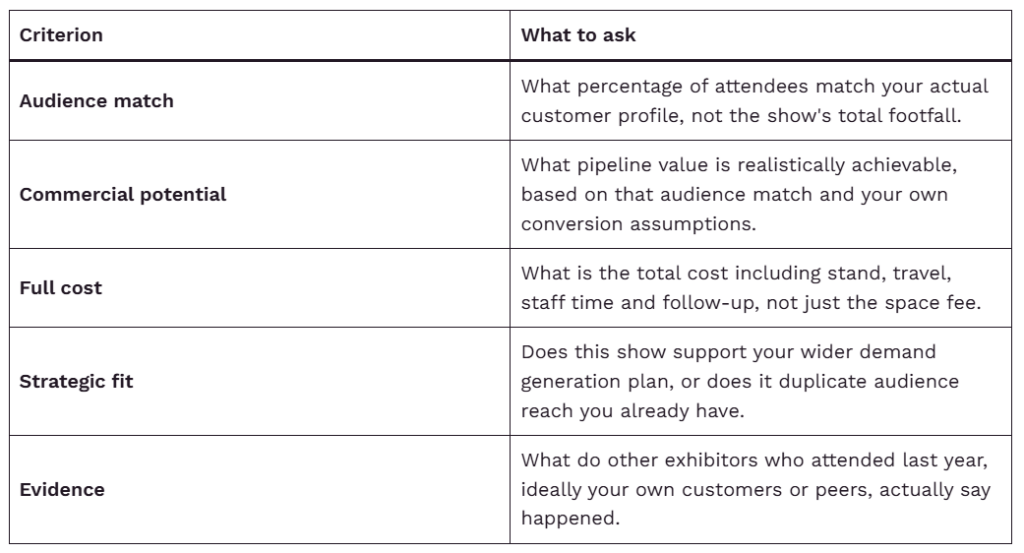
These criteria work together rather than in isolation. A show with strong footfall but a weak audience match should score lower overall than a smaller show that reaches the right buyers precisely. Equally, a show with excellent audience fit but a full cost that has crept up faster than the pipeline it produces deserves the same scrutiny as one that never worked at all.
Run your own numbers for commercial potential through the same formula as our exhibition ROI calculator. Turn the second criterion from a guess into a forecast you can defend to stakeholders.
How to Tell When You Have Outgrown a Show
A show that once delivered reliably can stop earning its place without anyone noticing in time, because the change is rarely dramatic enough to trigger a review on its own.
The single question that cuts through most effectively: would this show still make your shortlist if you were evaluating it for the first time today, with no history and no sunk cost attached? If the honest answer is no, habit rather than performance is keeping it in the calendar, and that budget would do more for the business elsewhere.
Watch for an audience that has drifted away from your actual buyers as the show has grown or repositioned. A cost that has risen faster than the results it produces. A stand that has become one familiar name among many rather than a reason for the right visitors to seek you out.
None of these warning signs need appear simultaneously; a show can fail on one or two of the five trade show selection criteria for several years before anyone totals the cumulative effect on return.
Building a Repeatable Selection Process
A selection process only earns the name if it runs the same way every time, regardless of who is making the case for a particular show. Score every show against the same five trade show selection criteria before any budget discussion begins. That way, the strongest argument in the room is the scorecard rather than whoever feels most strongly about a particular event.
Review the full shortlist annually rather than show by show. A calendar reviewed one event at a time tends to keep everything that was already there, while reviewing the whole calendar at once forces a genuine choice between competing options. Apply the same evaluation both when a show is first proposed and again after it has run, so new additions and long-standing fixtures face identical scrutiny.

Over several cycles, this turns show selection from an annual debate into a documented record your team can learn from, with every decision and its outcome in one place rather than scattered across emails and memory.
Frequently asked questions
How do you evaluate a trade show before committing?
Score it against five criteria: how well its audience matches your customer profile, its realistic commercial potential, its full cost including stand, travel, staff time and follow-up, how it fits your wider marketing plan, and the evidence from anyone who has exhibited there before.
A show that cannot earn a credible answer on each of these is not worth the budget.
Are trade shows worth it?
For considered B2B purchases with a defined buyer audience, exhibitions can be one of the most efficient channels available, since they put your team in front of qualified buyers who have already chosen to be in the room. Whether a specific show is worth it depends entirely on audience match and full cost, which is why a blanket answer about the channel as a whole is less useful than evaluating each show on its own merits.
What criteria should you use to choose a trade show?
Audience match, commercial potential, full cost beyond the space fee, strategic fit with your wider demand generation plan, and evidence from previous exhibitors are the five that predict whether a show earns its budget.
Footfall and exhibitor numbers alone, the figures most organiser media packs lead with, predict very little on their own.
How many trade shows should a company exhibit at each year?
There is no reliable figure that holds across sectors, since the right number depends on how many shows in your industry genuinely reach your buyer profile and what budget is available to do each one properly.
A shorter list of shows resourced well tends to outperform a longer one spread thin, which is a more useful guide than any specific count.
How do you know when to drop a trade show from your calendar?
Ask whether the show would still make your shortlist if you were evaluating it for the first time today, with no history attached. If the honest answer is no, it is being kept by habit rather than performance, and the budget would do more somewhere else.
Download our show-selection scorecard to run your own shortlist through these five criteria, or get in touch and talk it through with a team that has spent twenty years watching which shows deliver and which coast on reputation. We will help you build a calendar that earns its budget show by show.