The Hidden Cost of Booking Your Stand Too Late
The question of when to book a trade show is one that most exhibiting businesses answer reactively rather than strategically. You get a call from an organiser, a deadline is mentioned, and a decision gets made under time pressure that should have been made months earlier in a considered way. The consequences of booking late are more significant than most teams realise, and not just because early-bird space fees are lower.
The Timeline That Most Teams Work To Isn’t Enough
The most common booking pattern for mid-market B2B exhibitors is to confirm a show three to four months before the event date. That feels like reasonable lead time. It is not. By that point, the best floor positions have already been taken. The design process if done properly takes four to eight weeks for a stand of any complexity.
Production and fabrication take another four to six weeks after sign-off. Add logistics planning, graphics production, and any technology integration, and a four-month runway is genuinely tight for a well-executed result. A two-to-three month runway is a recipe for compromise.
For priority shows, the events that are central to your commercial calendar, the benchmark should be booking twelve months in advance where possible, and no later than six months before the event date.
What ‘Booking’ Actually Means at Each Stage
It is worth distinguishing between different phases of commitment. Space reservation with an organiser can often be done with a deposit and a broad space requirement, well before your stand design is finalised.
That early reservation secures your position on the floor and your choice of location. The design brief, contractor appointment, and creative development can follow in the subsequent weeks. Treating these as a single decision that all has to happen simultaneously is what creates unnecessary time pressure.
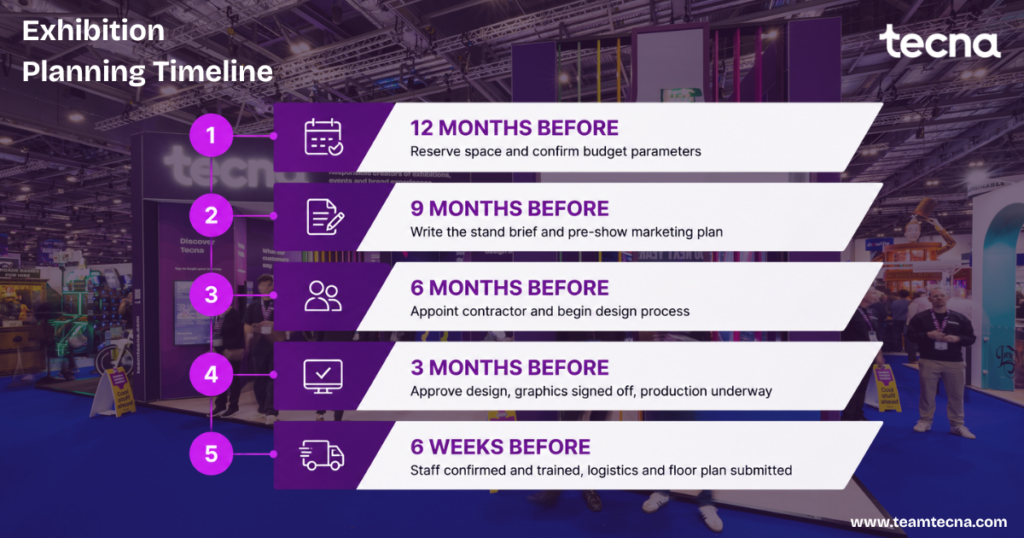
The Six-to-Twelve Month Window: What to Do When
Twelve months before the event
Confirm attendance in principle and reserve your space. This is particularly important for major shows at places like NEC Birmingham and Excel London, or any conference that has waiting lists or limited premium positions. At this stage you are not committing to a design, only to a presence. Agree budget parameters internally so the brief can be written properly when the time comes.
Nine months before the event
Write the stand brief. Define your specific objectives for the show, be sure to build in measurable outcomes. Identify which of those objectives the stand needs to support physically. At this stage you should also be defining your pre-show marketing plan: account targeting, outreach to existing contacts, and any show-specific content that needs to be created.
Six months before the event
Appoint your stand contractor and begin the design process. This is the minimum lead time for a stand of meaningful complexity. For modular builds at the simpler end, five months can work. For anything bespoke, double-storey, or with significant technology integration, six months is the floor. At this stage your contractor should be producing initial concepts and three-dimensional visualisations for review.
Three months before the event
Design should be approved and production should be underway. Graphics need to be finalised and signed off by this point for most production workflows. Pre-show marketing should be in active delivery, invitations, content, paid targeting to the show audience. Any technology elements should be specified, ordered, and in testing.
Six weeks before the event
Stand staff confirmed, briefed, and if they have not done it before, trained. Logistics confirmed with the organiser and the contractor. Floor plan and rigging drawings submitted where required. Show manual obligations completed. Any hospitality or meeting booking made for on-stand use.
The Real Cost of Booking Late
Late booking does not just create time pressure. It creates a cascade of compromises, each of which costs commercial performance. Poor floor positions generate less footfall. Compressed design timelines produce less considered creative.
Rushed production reduces quality. Late pre-show marketing reaches fewer target accounts before they finalise their show schedules. Each of these individually is manageable. Together they add up to a stand that is more expensive per qualified conversation than it needed to be.
The businesses that extract the most value from exhibition investment are almost always the ones with the longest lead times. Not because they spend more, but because they make better decisions at every stage when they are not under pressure.
When Late Booking Is Unavoidable
Sometimes a show comes into your calendar late, a new event launches, a client relationship creates an unexpected opportunity, or a competitor’s absence creates a position worth taking. In those situations, having a contractor who can move quickly and has modular or hybrid systems available is genuinely valuable.
Tecna regularly works with businesses on compressed timelines, but the honest answer is that compressed timelines always involve a trade-off somewhere. Being clear about what you are willing to trade, size, complexity, or certain features makes those conversations faster and the outcomes better.
If you are reviewing your exhibition calendar for the next 12 months, now is the right time to have a booking conversation for your priority shows, regardless of how far away they feel