Exhibitions aren’t going anywhere. They’re evolving.
If you’ve been following the commentary around trade shows over the past few years, you could be forgiven for assuming the exhibition hall is living on borrowed time or dare we paraphrase AI: “dead”. With tighter marketing budgets and a steady stream of thought leadership pieces pointing towards its decline.
The picture on the ground looks rather different, with private equity backing some of the UK’s biggest organisers and venues across Europe reporting healthy revenue growth.
Tecna, the UK-based design and build partner behind thousands of brands stands across UK and global venues, as well as full-show delivery for Informa’s AI Summit London and the Argus Media Biomass Conference, has been thinking about what comes next.

Leading its marketing is Anoushka Dovey, who has spent the past year rethinking how Tecna talks to the marketing and events managers it works with, and what a stand, and indeed an entire show, should really be doing for a brand.
She spoke with our comms team about where the industry is heading and more.
Some people say exhibitions are back, others that they’ve had their day. Where do you land?
Somewhere in the middle, but firmly on the optimistic side. When I hear people describe trade shows and exhibitions as a relic of the pre-digital age, I think they are picturing the exhibitions of twenty years ago, with a logo wall, a stack of print brochures and a bowl of sweets on the counter, and honestly, that version deserves to disappear.
What hasn’t changed is why people go in the first place. Exhibitions are essentially places of discovery, where buyers can meet the people behind a product and experience it in a way no webinar or website can replicate.
The visitor has changed enormously, though. Today’s buyer arrives having already researched, compared and shortlisted, so a stand built to introduce a brand from scratch is really solving a problem that no longer exists. The challenge for all of us is reinvention and experience.
What does Tecna want to be known for as the industry changes?
We want to bring a level of strategic thinking to the mid-market that has traditionally been reserved for the very largest global brands. Most of the brands we work with are investing somewhere between £20,000 and £200,000 in a stand, and at that level the marketing manager signing it off is under real pressure to prove it was worth every penny.
Yet much of the conversation in our industry is still about what a stand looks like rather than what it achieves. Our ambition is to push the possible on both fronts, so a bold, beautiful, dare I also say sustainable build, also becomes one of the most measurable channels in a brand’s marketing plan. Whether a project is modular, or fully bespoke, or £5k or £500k it should start with a clear commercial objective and be designed backwards from there.
At Tecna, we’re very deliberately developing our departments with a future focus so our expertise is expansive and set up in-house; the impact of this for our clients is really outstanding.
You work across very different shows and sectors. How do you approach that?
Every show is its own market, with its own audience, rhythm and expectations, so we never approach two in the same way.
The visitor walking the floor at an energy storage show behaves very differently from someone at an events industry show, and the stand has to respond to that. We are based in the UK but increasingly work internationally, and the same principle holds wherever we are building. There are always layers of a project we are expertly managing from venue compliance and standards to cultural understanding and expectations.
Full-show projects have taught us a great deal here. When we delivered The AI Summit London for Informa, we were designing a system that let more than eighty exhibitors each express themselves while the visitor experience still worked as a whole. We’ve also been supporting clients with their global exhibition calendars and supporting them to redefine their stands in different locations and situations.
That thinking now informs how we design individual stands too, because every stand sits within a wider ecosystem, not just form a logistics perspective but also in regard to an individual show and the stands neighbours as well as their audience.
Plenty of brands are questioning which shows are worth their budget. What’s your advice?
Pick your battles carefully, and be honest about why you are there. The exhibition calendar can be one of the most unexamined line items in your marketing budget because of the challenge of proving ROI, with shows booked because they were booked last year or because a competitor is going. Neither of those is necessarily a good reason to commit significant spend. We would much rather see a brand exhibit at two shows brilliantly than at five shows half-heartedly, and we are happy to say so, even when it means a smaller project for us.
Being a trusted partner sometimes means helping a client decide not to do something. On the positive side of this however, our clients are growing and going from strength to strength, some of our longer term customers started our with £10k budgets, we now build them stands costing over £150k per show, we know and understand how to make an exhibition successful for our clients and we think it’s brilliant to be able to grow their exhibition calendar in partnership with them.
How important is creating space to pause on a stand, rather than filling every square metre?
Hugely important, and it is one of the areas I feel most strongly about. If you are obsessed with squeezing product, screens and messaging into every inch of floor space, you end up with a stand that feels overwhelming, and visitors move on without ever having a proper conversation or really any time to think about what your business could do for them.
Some of the most effective spaces we have created recently include somewhere to sit, a good coffee or a charging point, because those small comforts give people a reason to stay and give your team the chance to talk properly. Alternatively, really engaging activations have a fun factor that can delight your audience and really impact a visitor’s experience.
Accessibility belongs in that conversation as well.
The relationship with a visitor should be thought about in the long term, and a stand focused purely on scanning badges is taking a very short-term view.
Where does sustainability fit into your vision for the future?
Right at the centre of it.
Responsibility runs through everything we do at Tecna, from the way we handle a client’s budget to the way we care for the planet, and exhibitions have historically been a wasteful part of the marketing mix.
We design modular, reusable systems wherever we can, so a stand or elements of a stand can be reconfigured rather than skipped at the end of a show, and we offer sustainability reporting for clients too so they can see the impact for themselves.
Showing your exhibition programme is both commercially effective and genuinely responsible really just makes ethical sense and we want to help our customers do both.
What does the next five years look like for exhibitions?
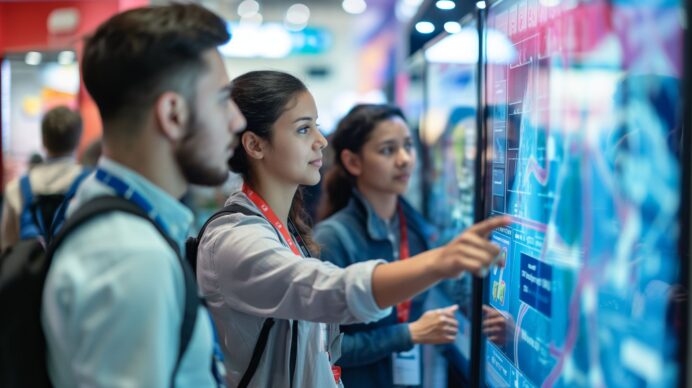
I think we will see stands become far more interactive and far more accountable at the same time. Gamification, personalised experiences and real-time engagement data are pushing visitors into active participants, and that participation is what people remember positively about a brand.
The other big change will be in how success is measured, moving away from footfall towards the pipeline a show creates in the months that follow. For us, that means being involved earlier, helping brands and show organisers shape their objectives from the initial brief, and staying with them through the post-show follow-up.
Tecna never settles for boring, and we don’t think our clients should either.