Low audience attention at a trade show is almost always a design and staffing problem, not a product problem. Visitors typically decide whether to stop at a booth within 3–15 seconds, and that decision is made before most exhibitors get the chance to say anything.
Fixing low engagement means addressing what happens in that window, in addition to what happens after someone walks in.
Here’s what’s driving low attention on the show floor, and the specific fixes that can fix the problem.
Why Attention Is Genuinely Harder to Win Now
Visitors are processing dozens, if not hundreds of competing stands, staff, signage, and noise at once. Research on visual perception shows people form initial judgements about what they’re looking at in a fraction of a second, long before conscious evaluation kicks in. On a crowded aisle, that means a booth either reads clearly at a glance or it doesn’t.
According to Event Marketer’s EventTrack 2025 report, close to half of trade show attendees (46%) spend only 15–30 minutes inside any single booth across a full show day, which means the opportunity to capture those attendees is limited.
The Real Causes of Low Audience Attention at a Trade Show (and Fixes)
1. The Booth Doesn’t Communicate From the Aisle
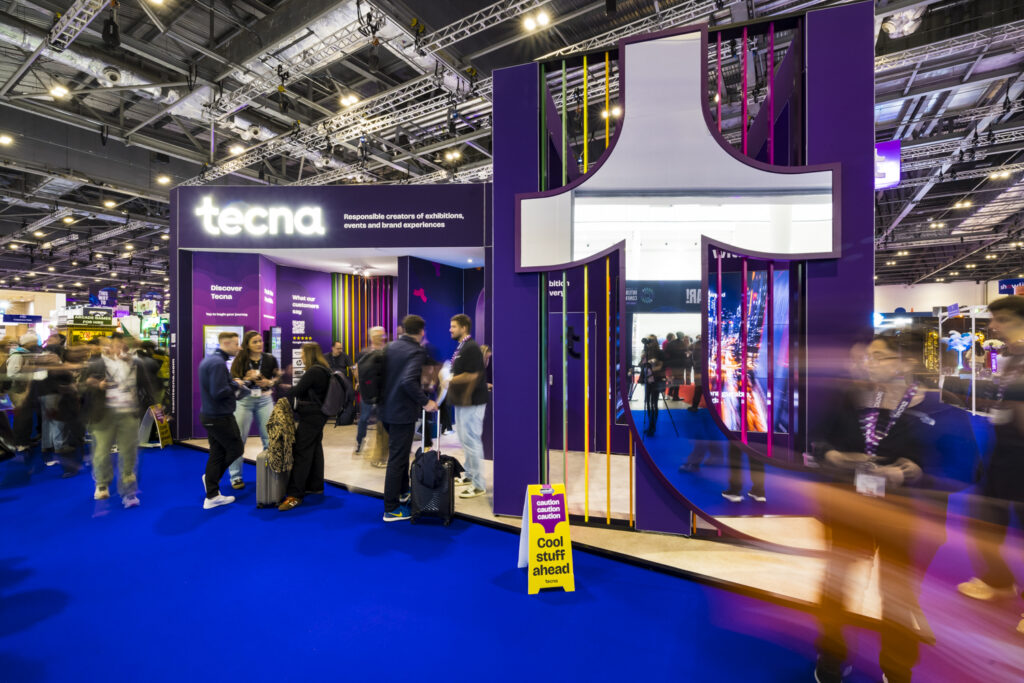
If a visitor can’t tell what you do within a few seconds from 10 metres away, they won’t stop to find out. This usually comes down to graphics and lighting rather than layout directly. Bold, legible messaging and strong backlighting consistently outperform cluttered signage or product-only displays.
Fix: Lead with a clear, benefit-led headline visible from the aisle, not a logo alone. Prioritise contrast and lighting over smaller decorative details.
2. The Layout Blocks Entry
Closed-off stands, reception-desk barriers, or dense furniture at the entrance all signal “not open” to a passing visitor, even if that’s unintentional.
Fix: Design open sightlines from at least two sides of the stand, and keep the first few metres of floor space free of obstacles and be mindful of how counters can act as a blocker.
3. There’s Nothing Active Happening
A static display with a static team reads as low-energy, even with great products. Live demonstrations pull attention in a way that signage and screens alone can’t; active product demonstrations have been linked to significantly higher lead volumes compared with passive display alone.
Fix: Schedule visible, repeated demonstrations rather than one-off presentations, so there’s always something happening when someone glances over.
4. Staff Are Reactive Instead of Proactive
This is the factor most exhibitors underinvest in relative to its impact. Booths where staff initiate conversation are recalled significantly more often than booths where staff wait to be approached, and trained, briefed staff consistently produce longer visitor dwell times than untrained internal teams.
Fix: Brief staff specifically on approach technique, not just product knowledge. Standing with open body language near the aisle edge, rather than behind a desk, measurably increases stop rate. There are also opportunities to hire staff and your stand builder should be able to guide you through the cost and what that could look like in practice.
5. There’s No Reason to Stay Once Someone Stops
Getting a visitor to stop is only half the problem, many booths lose people again within the first minute because there’s nowhere comfortable to linger and nothing sequential to explore.
Fix: Build in zones, a draw at the front, a demonstration or conversation area in the middle, and seating or hospitality further in, so dwell time increases naturally as visitors move deeper into the stand.
What to Measure
Attention problems are only solvable if they’re measured, not guessed at:
- Stop rate — the proportion of passing traffic that stops at the stand
- Dwell time — how long visitors stay once they’ve stopped
- Return visits — whether visitors come back later in the show, a strong signal of genuine interest
Tracking these across a show, even informally, via staff observation tells you whether the problem sits at the aisle (stop rate), in the stand (dwell time), or in the follow-up.
Frequently Asked Questions
How long do visitors spend deciding whether to stop at a booth? Industry research consistently points to a window of roughly 3–15 seconds meaning the graphics, lighting, and open sightlines at the front of a stand matter more than almost anything else in the design.
Does booth size affect attention, or is it mostly design? Design and clarity of message tend to matter more than raw square metreage. A smaller, well-lit stand with clear messaging and active demonstrations regularly outperforms a larger but visually cluttered one.
What’s the single highest-impact fix for low audience attention at a trade show? Staff behaviour. Proactive, trained staff standing at the aisle edge rather than waiting behind a desk is consistently the fastest and cheapest fix; it doesn’t require a redesign, just a change in briefing and positioning.
Tecna designs exhibition stands built to earn attention on a crowded show floor, from aisle-facing graphics to layouts that guide visitors deeper in. Get in touch to talk through your next stand.